

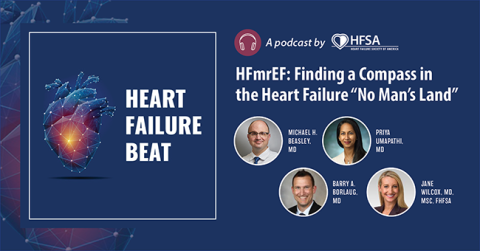
Heart failure with mildly reduced ejection fraction (HFmrEF) affects up to one in four patients with heart failure, yet it remains one of the most misunderstood and under-discussed phenotypes in clinical practice. In this episode of Heart Failure Beat, hosts Michael Beasley, MD, and Priya Umapathi, MD, sit down with Jane E. Wilcox, MD, and Barry A. Borlaug, MD, co-lead authors of the newly published HFSA Scientific Statement: Heart Failure with Mildly Reduced Ejection Fraction, to discuss why this patient population deserves greater attention.
The conversation explores how HFmrEF fits between HFrEF and HFpEF, why ejection fraction alone may not tell the whole story, practical treatment considerations, and the important concept of HFmrEF as both an overlap and transitional state.
Read the Scientific Statement: HFSA Scientific Statement: Heart Failure with Mildly Reduced Ejection Fraction
Published in the June 2026 issue of the Journal of Cardiac Failure.
Listen below and subscribe: Apple Podcasts, Amazon Music, Spotify, Podcast Home
Tune into highlight clips on YouTube





References, Links and Disclosures
Barry A. Borlaug, MD: Research Support:
NIH/NHLBI, US Dept of Defense, Axon, AstraZeneca, Corvia, Medtronic, Tenax Therapeutics
Consulting/Advisory Board:
Actelion, Amgen, Aria, Boehringer Ingelheim, Edwards, Eli Lilly, Imbria, Janssen, Merck, Novo Nordisk, VADovations
Jane Wilcox, MD, MSc, FHFSA: Consultant/Advisory Board/DSMB/CEC: Abbott, Cytokinetics, IONIS, FIRE1, Johnson and Johnson Med Tech
June (2026) issue of the Journal of Cardiac Failure
Disclaimer
The opinions and perspectives expressed in this episode are those of the individual guests and hosts and do not necessarily reflect the official views of the Heart Failure Society of America (HFSA). This discussion is intended for educational purposes only and does not constitute medical advice or an endorsement of any specific pharmaceutical product or therapy. HFSA does not endorse one medication over another. Patients should consult their healthcare professionals for individualized evaluation and treatment decisions.